MEET THE ARTIST
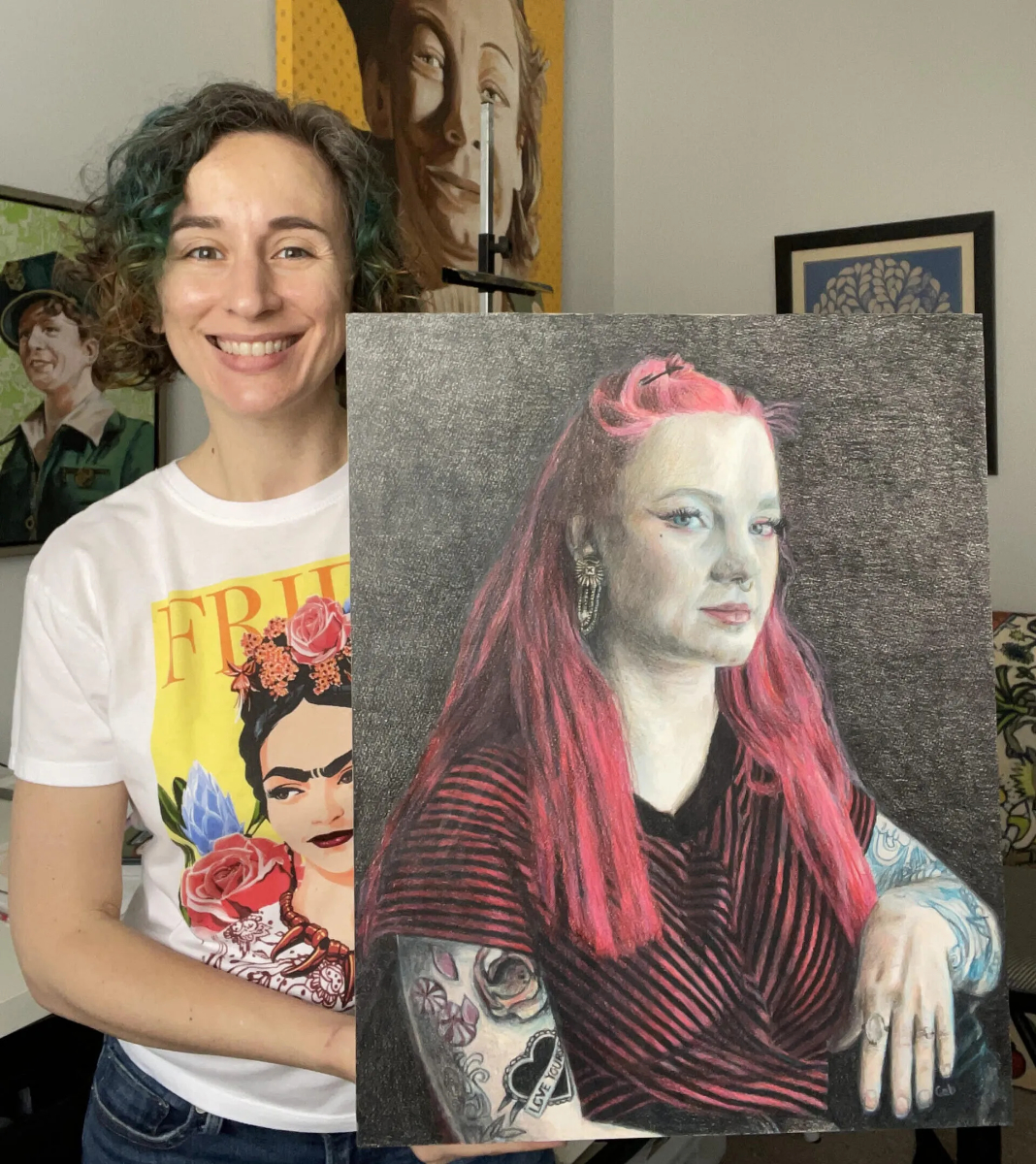
My name is Carrie Brummer. I create work that examines caregiving, power, and identity through moments that feel both familiar and quietly dissonant.
My Anonymous Woman series centers on women whose stories often go unseen, exploring presence, erasure, and the tension between visibility and anonymity. That body of work continues to inform my practice, grounding it in a sustained attention to whose experiences are remembered, and how.
Becoming a mother shifted both my life and my work.
It brought me face to face with a tension I could not ignore: the deep devotion of caring for another alongside the pressure to do it perfectly. That experience opened into a broader investigation of the systems that shape us, the roles we perform, and the expectations we carry, often without question.
I work primarily in drawing and fiber, using materials tied to domestic life such as colored pencil, embroidery, and repurposed fabrics. These processes are slow and interruptible. They mirror the rhythms of caregiving while also holding space for reflection. Marks accumulate. Threads hold memory. Surfaces become sites where personal and social histories overlap.
My compositions often place figures within altered or unexpected contexts.
Authority figures may appear in childlike spaces. Familiar environments shift in scale or logic. At times, images unfold through non sequiturs, where meaning is not fixed but felt. These disruptions create distance from expected narratives, allowing new questions to surface.
Through this play with context and environment,
I explore how power is learned, embodied, and reinforced, and how it might be reimagined.
The work moves between observation and invention, drawing from lived experience while opening into something less certain and more speculative.
I return again and again to the everyday. Small gestures, overlooked moments, and quiet contradictions become entry points into larger conversations about labor, authority, gender, and care.
At its core, my practice is about noticing and reframing.
It invites a pause in what we think we understand, making space for complexity, ambiguity, and the possibility of seeing differently.